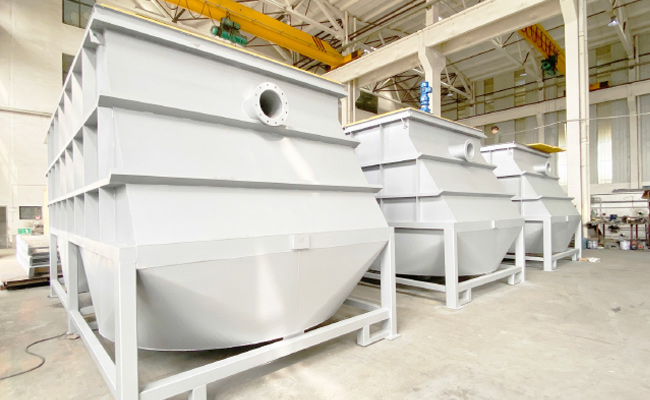
Product Detail
Water Treatment Expert · High-Efficiency Physical-Chemical Technology
Water Treatment Expert · High-Efficiency Physical-Chemical Technology
The Lamella clarification system is based on the 'shallow pool theory' proposed by German Professor Hazen in the early 20th century. Its core principle states that settling capacity is related to the settling tank area, not its depth. The lamella settling area is the cumulative projected area of inclined plates.
The WPL Lamella Clarifier adopts inclined-plate (tube) sedimentation theory. Compared with conventional sedimentation tanks, it offers 3–5× higher treatment capacity per unit area; suitable for industrial wastewater and heavy metal removal treatments. Widely applied to metal hydroxide wastewater, electroplating effluent, pulp & paper mills, municipal sewage, printing & dyeing wastewater, steel industry, phosphorus removal, tannery effluent, and other impurity removal scenarios.
Inclined-plate sedimentation area enlarged to 3–5× that of conventional tanks; compact structure with outstanding performance
Suitable for metal hydroxide wastewater, electroplating effluent, printing & dyeing, steel, tanneries and other industrial wastewater
Robust construction, low failure rate, easy day-to-day maintenance and management
Heavy metal, electroplating, printing & dyeing wastewater
Primary clarification and sludge thickening
Chemical phosphorus precipitation treatment
Leather industry wastewater treatment
| No. | Model | Daily Capacity (t) | Footprint (m²) | Installed/Operating Power (kW) | Notes |
|---|---|---|---|---|---|
| 1 | WPL-10 | 10 | 2–3 | 1.5/1 | Standard configuration |
| 2 | WPL-50 | 50 | 8–12 | 4/2.5 | Standard configuration |
| 3 | WPL-100 | 100 | 15–20 | 7/5 | Standard configuration |
| 4 | WPL-500 | 500 | 60–80 | 28/18 | Standard configuration |